
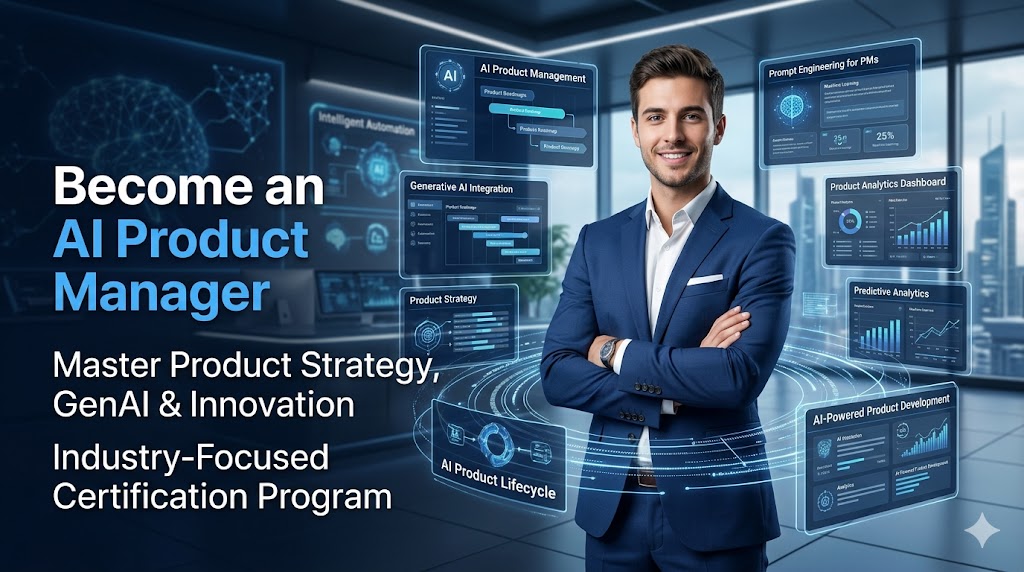
Are you looking for Best Product Manager with AI Course in Delhi | AI Product Management Certification
Looking for the best Product Manager with AI course in Delhi? Learn AI Product Management, Generative AI, Product Strategy, Prompt Engineering, AI Product Development, and Product Analytics to advance your career.
Artificial Intelligence is no longer a futuristic concept—it is transforming how businesses build, launch, and scale products across industries. From healthcare and finance to e-commerce and education, companies are increasingly looking for professionals who can bridge the gap between technology and business strategy. This demand has created a new generation of leaders skilled in AI Product Management.
If you are aspiring to become a successful product manager, enrolling in an Artificial Intelligence for Product Managers course in Delhi can be one of the smartest career decisions you make. Modern product managers are expected to understand not only traditional product management principles but also emerging technologies such as Generative AI (GenAI), machine learning, automation, and intelligent systems.
The best Product Manager with AI course in Delhi equips learners with practical skills in AI-Powered Product Development, Product Strategy & Roadmapping, AI Product Discovery, and AI-Driven Decision Making. These programs help professionals understand how AI products are conceived, developed, tested, launched, and scaled in competitive markets.
Whether you are a student, entrepreneur, business analyst, software professional, or aspiring product leader, this guide will help you understand what makes an AI product management course valuable and how it prepares you for the future of product innovation.
The role of product managers has evolved significantly over the past decade. Traditionally, product managers focused on customer needs, market research, and business objectives. Today, they must also understand AI technologies and how they can create business value.
Modern organizations require professionals who can oversee the complete AI Product Lifecycle, from idea generation to deployment and continuous optimization. Successful AI product managers combine technical awareness with business strategy, enabling them to lead cross-functional teams effectively.
A comprehensive AI product management course teaches:
These capabilities allow product managers to identify opportunities where AI can solve real customer problems and create competitive advantages.
For example, an e-commerce company may use AI-powered recommendation engines to increase sales. A healthcare platform may leverage predictive models to improve patient outcomes. In both scenarios, product managers play a crucial role in defining product vision and ensuring successful execution.
A strong foundation begins with understanding Machine Learning Integration and how AI technologies work in practical business environments.
Students learn:
This knowledge helps product managers communicate effectively with engineers and data scientists.
An essential component is understanding the AI Technology Stack, which includes:
Understanding these components enables better product planning and execution.
One of the most exciting developments in recent years is Generative AI (GenAI).
AI product management programs now include modules on:
A critical skill in this area is Prompt Engineering, which involves designing effective prompts to maximize AI performance.
Product managers who understand prompt design can build better AI-driven customer experiences and improve productivity across organizations.
Another emerging area is Agentic AI, where AI systems perform tasks autonomously while pursuing defined goals.
These systems are increasingly used for:
Understanding AI Workflow Automation enables product managers to design products that reduce manual effort while increasing efficiency.
The success of any product depends on solving real customer problems. This is where Customer Journey Mapping becomes essential.
By understanding customer pain points, product managers can design meaningful experiences that improve engagement and retention.
Courses often teach:
These skills support Human-Centered AI Products, ensuring technology enhances rather than complicates the user experience.
Before building an AI solution, product managers must determine whether there is genuine market demand.
Through Market Opportunity Analysis, students learn how to:
This process reduces the risk of building products nobody wants.
Modern product teams increasingly use AI-Enhanced Market Research tools to gather insights faster and more accurately.
AI can help:
This allows product managers to make more informed decisions.
Understanding competitors remains a critical responsibility.
Through Competitive Product Analysis, students learn how to evaluate:
These insights contribute to stronger product differentiation and growth strategies.
Every successful product begins with a concept that is validated through experimentation.
A top AI product management course teaches Minimum Viable Product (MVP) Development, enabling learners to:
Instead of building complex solutions immediately, teams create focused versions that address core user needs.
Before full-scale development, teams often engage in AI Product Prototyping.
This stage allows stakeholders to:
Prototypes reduce uncertainty and improve development efficiency.
One of the most important skills for product managers is creating a strong Product Requirements Document (PRD).
A PRD defines:
Clear documentation ensures alignment among stakeholders.
Modern organizations rely on AI-Powered Product Development methodologies that combine data insights with rapid experimentation.
This includes:
Such approaches significantly improve development outcomes.
Customers increasingly expect intelligent functionality.
Examples of AI-Powered Features include:
Product managers must understand how to prioritize and implement these features effectively.
The best decisions are based on evidence rather than assumptions.
Data-Driven Product Management empowers leaders to:
Product managers learn how to use data throughout the product lifecycle.
One of the most valuable tools in a product manager’s toolkit is Product Analytics.
Analytics help answer questions such as:
These insights guide future improvements.
Understanding customer actions is essential.
User Behavior Analytics allows teams to:
Behavioral insights often reveal opportunities that traditional surveys miss.
Once a product launches, continuous Product Performance Monitoring becomes critical.
Monitoring helps teams track:
Continuous monitoring ensures products remain competitive and valuable.
Successful AI products require specialized measurement frameworks.
Common AI Product Metrics include:
These metrics help organizations evaluate AI effectiveness.
Advanced organizations leverage Predictive Analytics to anticipate future trends.
Predictive models can forecast:
This enables proactive decision-making.
Innovation requires continuous learning.
A/B Testing helps teams compare alternative solutions and determine which performs better.
Alongside testing, Model Experimentation enables organizations to optimize AI models before full deployment.
As AI adoption grows, ethical considerations become increasingly important.
The best AI product management programs emphasize AI Ethics & Responsible AI practices.
Students learn how to address:
Responsible AI builds trust and reduces organizational risk.
Strong AI Product Governance frameworks ensure AI systems operate safely and effectively.
Governance includes:
Organizations increasingly prioritize governance as AI becomes mission-critical.
Before implementing AI solutions, businesses must assess their readiness.
AI Capability Mapping helps organizations understand:
This enables realistic planning and execution.
Continuous AI Product Evaluation ensures products remain effective over time.
Evaluation processes focus on:
Regular evaluation helps teams maintain long-term success.
Launching a product is only the beginning.
AI Product Scaling involves expanding products to support larger audiences while maintaining performance and reliability.
Scaling requires:
These capabilities are essential for sustainable growth.
Technical knowledge alone does not guarantee success.
The best product managers excel at communication, collaboration, and leadership.
Programs often emphasize Stakeholder Collaboration in AI Products, teaching students how to align:
Strong collaboration ensures successful product execution.
Modern leaders need a strong understanding of AI concepts without necessarily becoming data scientists.
AI Literacy for Product Managers enables professionals to:
Growth-oriented organizations rely on proven Product Growth Frameworks to increase adoption and revenue.
These frameworks help teams:
One of the most important goals for any product manager is achieving Product-Market Fit.
This occurs when a product effectively solves a customer problem and experiences strong market demand.
Without product-market fit, scaling efforts often fail.
Long-term success requires structured planning.
AI Roadmap Planning helps organizations prioritize initiatives, allocate resources, and align product goals with business objectives.
Effective leaders understand Product Lifecycle Management, ensuring products evolve successfully from launch through maturity and eventual transformation.
Continuous AI Product Innovation enables organizations to remain competitive in rapidly changing markets.
Innovation often emerges from:
Ultimately, successful professionals develop strong AI Product Leadership skills that combine vision, execution, collaboration, and strategic thinking.
The demand for skilled AI product managers is growing rapidly, making now the perfect time to invest in your future. The best Product Manager with AI course in Delhi goes far beyond traditional product management by combining business strategy, technology, analytics, leadership, and innovation.
By mastering AI Product Management, Artificial Intelligence for Product Managers, Generative AI (GenAI), AI Product Discovery, AI Product Design, AI Strategy, AI Product Validation, AI Product Launch Strategy, and AI Product Scaling, professionals can position themselves at the forefront of the digital economy.
A high-quality program should provide hands-on experience with Prompt Engineering, Machine Learning Integration, Predictive Analytics, Product Analytics, AI Product Governance, and AI Ethics & Responsible AI while preparing learners to lead the next generation of intelligent products.
As businesses continue embracing AI, organizations will increasingly seek professionals who can transform ideas into impactful solutions. If you aspire to become a future-ready product leader, enrolling in a comprehensive AI Product Management course in Delhi could be the career-defining step that unlocks new opportunities, higher earning potential, and long-term professional growth.
SkillPerform’s AI Product Management program is designed to meet current industry demands, covering essential topics such as AI Product Management, Generative AI, Prompt Engineering, AI Product Discovery, and Product Strategy & Roadmapping.
Gain insights from experienced product leaders, AI practitioners, and industry professionals who bring real-world case studies and practical knowledge into the classroom.
Work on live projects, product simulations, and practical assignments that help you apply concepts like AI Product Design, MVP Development, Product Analytics, and AI Product Validation in real business scenarios.
Master emerging technologies including Agentic AI, AI Workflow Automation, Machine Learning Integration, and AI-Powered Product Development to stay ahead in the evolving product management landscape.
Develop expertise across the complete AI Product Lifecycle, from Market Opportunity Analysis and Customer Journey Mapping to AI Product Launch Strategy and AI Product Scaling.
Learn how to leverage Generative AI (GenAI) tools and advanced Prompt Engineering techniques to enhance productivity, innovation, and product decision-making.
Build strong analytical capabilities through training in Predictive Analytics, Product Analytics, User Behavior Analytics, A/B Testing, and AI Product Metrics.
Whether you are a student, entrepreneur, business analyst, or aspiring product manager, SkillPerform helps you develop job-ready skills aligned with today’s AI-driven business environment.
Understand the importance of AI Ethics & Responsible AI, AI Product Governance, and compliance frameworks to build trustworthy and sustainable AI products.
Develop strategic thinking through AI Strategy, AI Roadmap Planning, Product Growth Frameworks, and AI Product Leadership, preparing you for high-impact leadership roles in the future.
Create real-world product case studies, AI product prototypes, and strategic product documents that strengthen your professional portfolio and showcase your capabilities to employers.
Earn a certification that validates your expertise in AI-powered product management and demonstrates your readiness to lead innovation in modern organizations.
Connect with mentors, industry professionals, and fellow learners while gaining exposure to career opportunities in the rapidly growing field of AI product management.
Learn how to build Human-Centered AI Products that balance technological innovation with exceptional user experiences and business outcomes.
From AI Use Case Identification and Competitive Product Analysis to AI Product Innovation and long-term product growth, SkillPerform equips learners with a complete product management toolkit.
SkillPerform empowers aspiring product managers with the knowledge, practical experience, and AI expertise needed to build, launch, and scale successful AI-powered products in today’s digital economy.
An AI Product Management course teaches professionals how to build, manage, launch, and scale AI-powered products by combining product management principles with artificial intelligence technologies.
Students, product managers, business analysts, entrepreneurs, software professionals, project managers, and anyone interested in AI-driven product development can enroll.
You will learn AI Product Management, Product Strategy, Prompt Engineering, AI Product Discovery, AI Product Design, Product Analytics, and AI Product Scaling.
No. Most AI Product Management courses are designed for both technical and non-technical professionals.
Generative AI refers to AI systems that can create content, automate workflows, generate ideas, and assist in product innovation.
Prompt Engineering helps product managers interact effectively with AI models, improving outputs and enhancing AI-powered features.
AI Product Discovery is the process of identifying opportunities where artificial intelligence can solve customer problems and create business value.
AI helps product managers make data-driven decisions, forecast trends, identify opportunities, and optimize product roadmaps.
AI-powered features include recommendation engines, chatbots, predictive search, personalization, and automated decision-making systems.
The AI Product Lifecycle covers ideation, development, testing, deployment, monitoring, optimization, and scaling of AI products.
Product Analytics helps measure user engagement, feature adoption, retention, and overall product success.
Predictive Analytics uses historical and real-time data to forecast future customer behavior and business outcomes.
AI Product Design focuses on creating user-friendly and intelligent product experiences powered by AI technologies.
AI Product Validation ensures that AI solutions solve real user problems and deliver measurable business value.
Minimum Viable Product (MVP) Development involves creating a simplified version of an AI product to test market demand quickly.
A PRD outlines product goals, features, user requirements, technical specifications, and success metrics.
AI Product Governance ensures responsible development, compliance, transparency, and ethical use of AI systems.
AI Ethics helps organizations prevent bias, protect user privacy, maintain transparency, and build customer trust.
Customer Journey Mapping visualizes user interactions with a product to identify pain points and opportunities for improvement.
Market Opportunity Analysis evaluates customer demand, competition, industry trends, and growth potential before product development.
AI Capability Mapping helps organizations assess their readiness, resources, data, and infrastructure for AI implementation.
AI Product Scaling involves expanding an AI solution to serve larger user bases while maintaining performance and reliability.
AI Workflow Automation uses AI technologies to automate repetitive business processes and improve efficiency.
Agentic AI refers to intelligent systems capable of performing tasks autonomously and making decisions toward defined goals.
A/B Testing compares different versions of a feature or product to determine which performs better.
Graduates can pursue roles such as AI Product Manager, Product Owner, Product Analyst, Growth Manager, Innovation Manager, and AI Strategy Consultant.
Product-Market Fit occurs when a product successfully solves a customer problem and experiences strong market demand.
AI Literacy helps product managers understand AI technologies, collaborate with technical teams, and make informed decisions.
AI Roadmap Planning involves creating a strategic plan for AI initiatives, feature development, and business goals.
Delhi offers access to top institutes, industry experts, networking opportunities, practical projects, and growing demand for AI product management professionals.
Also Read: Best cyber security with Ai course in Delhi








Your information will never be shared with any third party