


Are you searching for Best Cyber Security with AI Course in Delhi | AI Cybersecurity Training??
Learn AI-powered cybersecurity with the best cyber security with AI course in Delhi. Master threat detection, ethical hacking, SOC operations, and AI security.
The cybersecurity landscape is evolving faster than ever. As organizations continue to embrace digital transformation, cyber threats are becoming more sophisticated, frequent, and difficult to detect. Traditional security measures are no longer enough to combat modern cyberattacks. This is where AI-Powered Cybersecurity comes into the picture.
Artificial Intelligence is transforming how businesses identify, prevent, and respond to cyber threats. The integration of Artificial Intelligence for Cyber Security has created a new generation of professionals who understand both cybersecurity fundamentals and AI-driven defense mechanisms. As a result, the demand for skilled cybersecurity experts with AI knowledge is increasing rapidly across industries.
Delhi has emerged as one of India’s leading education and technology hubs, offering specialized training programs that combine cybersecurity expertise with artificial intelligence. Whether you are a student, IT professional, ethical hacker, or someone looking for a career switch, enrolling in the best cyber security with AI course in Delhi can open doors to exciting career opportunities.
In this guide, we will explore why AI is revolutionizing cybersecurity, what skills you should learn, and how the right training program can prepare you for the future of digital security.
Cybercriminals are continuously developing advanced attack methods that can bypass conventional security systems. Security teams often struggle to analyze vast amounts of data generated by networks, applications, and devices. This challenge has accelerated the adoption of Machine Learning for Cybersecurity and AI-based security solutions.
AI systems can process enormous volumes of security data in real time, identifying anomalies that might otherwise go unnoticed. Modern cybersecurity frameworks now rely on Threat Detection and Response mechanisms powered by machine learning algorithms capable of recognizing suspicious activities instantly.
For example, if an employee unknowingly clicks on a malicious email link, AI-powered systems can trigger Automated Incident Response, isolate affected devices, and prevent malware from spreading across the organization.
Similarly, advanced Phishing Detection tools use AI to analyze email patterns, sender behavior, and content characteristics to identify phishing attempts before they reach users.
Organizations worldwide are investing heavily in AI-driven security solutions because they improve accuracy, reduce response time, and strengthen overall cyber resilience.
The best cybersecurity programs go beyond theoretical knowledge. They provide hands-on experience, real-world simulations, and practical exposure to modern cyber defense tools.
A quality course should include comprehensive training in:
Before mastering AI-driven security systems, learners must understand foundational cybersecurity concepts such as:
These concepts form the backbone of every cybersecurity strategy. Students learn how organizations protect critical systems, sensitive data, and digital infrastructure from unauthorized access.
Modern cybersecurity professionals must understand how attackers think.
Courses that include Ethical Hacking with AI help students simulate real-world cyberattacks while leveraging AI tools to identify weaknesses faster.
Key topics typically include:
AI-enhanced penetration testing tools can automate vulnerability discovery and provide detailed security insights, helping organizations proactively strengthen their defenses.
Organizations increasingly rely on AI to support their Security Operations Center (SOC) teams.
A modern AI cybersecurity course should teach students how AI enhances:
Security analysts often face thousands of alerts daily. AI helps reduce alert fatigue by identifying the most critical threats requiring immediate attention.
The best cyber security with AI course in Delhi should prepare students for real-world security challenges.
One of the most valuable skills today is understanding Threat Intelligence.
Threat intelligence involves gathering, analyzing, and interpreting information about current and emerging cyber threats. By combining AI with intelligence gathering, security teams can predict attacks before they occur.
Students should also learn Cyber Threat Hunting, a proactive approach where security professionals actively search for hidden threats within systems and networks.
Unlike traditional monitoring, threat hunting focuses on discovering advanced threats that evade automated defenses.
Cybercriminals often follow recognizable behavioral patterns.
AI systems excel at Attack Pattern Analysis, identifying unusual activities that may indicate an ongoing breach.
For example, an employee logging in from multiple countries within a short timeframe may trigger security alerts. AI can quickly recognize such anomalies and initiate investigations.
Malware continues to evolve at an alarming pace.
Effective cybersecurity programs include advanced Malware Analysis techniques that help professionals understand how malicious software operates.
AI significantly improves malware detection by identifying suspicious behavior patterns rather than relying solely on known malware signatures.
As ransomware attacks continue to rise globally, malware analysis skills have become increasingly valuable.
Businesses are rapidly migrating their operations to the cloud while adopting connected devices across industries.
This shift has increased the importance of:
Cloud environments introduce unique security challenges.
Students must learn:
Modern AI tools continuously analyze cloud environments to identify misconfigurations and vulnerabilities before attackers exploit them.
The Internet of Things has expanded the cybersecurity attack surface dramatically.
From smart factories and healthcare devices to connected vehicles and home automation systems, IoT devices generate vast amounts of data.
An effective cybersecurity course should cover:
Strong IoT Security practices help organizations prevent unauthorized access to connected devices and networks.
Cybersecurity is not only about preventing attacks but also responding effectively when incidents occur.
Cyber Forensics involves investigating digital evidence to determine how attacks occurred and who was responsible.
Students learn:
AI accelerates forensic investigations by identifying relevant evidence faster and uncovering hidden attack indicators.
Modern Digital Forensics tools powered by AI can analyze millions of records in minutes, significantly reducing investigation timelines.
These capabilities are particularly useful during large-scale security incidents where rapid analysis is essential.
Every cybersecurity professional should understand structured Incident Handling and Response procedures.
Organizations need trained experts who can:
AI-driven automation has transformed response workflows by enabling faster containment and remediation.
As cyber threats continue to grow, manual security processes are becoming unsustainable.
This has led to widespread adoption of Security Automation technologies.
Automation allows organizations to:
AI-powered automation platforms can process thousands of events simultaneously while executing predefined response actions.
The future of cybersecurity will increasingly rely on autonomous security systems capable of making intelligent decisions in real time.
While AI strengthens security, cybercriminals are also using AI to launch more advanced attacks.
This has created a new field known as Adversarial AI Security.
Students must understand:
Learning these concepts ensures professionals can protect AI systems themselves from malicious exploitation.
Technical skills alone are not enough.
Organizations need cybersecurity professionals who can align security initiatives with business goals.
One of the most critical responsibilities in cybersecurity is conducting Risk Assessment and Mitigation.
Students should learn how to:
AI tools help organizations assess risks more accurately by analyzing historical attack data and emerging threat trends.
Effective Information Security Management ensures that security policies, procedures, and governance frameworks support organizational objectives.
Professionals trained in management principles are often better positioned for leadership roles such as Security Manager, SOC Manager, and Chief Information Security Officer (CISO).
The demand for AI-enabled cybersecurity professionals is growing across industries including banking, healthcare, government, e-commerce, manufacturing, and technology.
Popular career paths include:
Employers increasingly seek candidates who can combine cybersecurity expertise with AI knowledge, making this skill combination highly valuable in today’s job market.
The cybersecurity industry is entering a new era driven by artificial intelligence, automation, and advanced analytics. Traditional security approaches are no longer sufficient against sophisticated cyber threats. Organizations now depend on AI-Powered Cybersecurity solutions to strengthen Threat Detection and Response, improve Security Monitoring, support Cyber Defense Strategies, and enhance operational efficiency.
The best cyber security with AI course in Delhi should provide a balanced combination of cybersecurity fundamentals, AI technologies, practical labs, and real-world projects. From Threat Intelligence and Malware Analysis to Cloud Security, Cyber Forensics, Security Analytics, and AI Security Operations, a comprehensive training program can equip you with the skills needed to thrive in this rapidly evolving field.
As businesses continue investing in AI-driven security infrastructure, professionals who understand both cybersecurity and artificial intelligence will remain among the most sought-after experts in the technology industry. If you’re looking to build a future-proof career, now is the perfect time to enroll in a cybersecurity course that integrates the power of AI with modern digital defense strategies.
In today’s rapidly evolving digital landscape, choosing the right training institute can make a significant difference in your cybersecurity career. SkillPerform stands out as a trusted learning platform for aspiring cybersecurity and AI professionals by offering industry-relevant training, practical exposure, and career-focused learning.
SkillPerform’s Cyber Security with AI program is designed to match current industry requirements. The curriculum covers essential topics such as AI-Powered Cybersecurity, Threat Detection and Response, Ethical Hacking, Penetration Testing, Threat Intelligence, and Security Operations Center (SOC) practices.
Cybersecurity is a skill-driven field. SkillPerform emphasizes real-world learning through practical labs, simulations, case studies, and hands-on projects that help students apply theoretical concepts in realistic environments.
Unlike traditional cybersecurity courses, SkillPerform integrates Artificial Intelligence for Cyber Security, Machine Learning for Cybersecurity, Security Analytics, and Security Automation, preparing learners for the future of cyber defense.
Students learn from experienced industry professionals who bring practical insights, real-world attack scenarios, and current cybersecurity trends into the classroom.
The program covers critical cybersecurity domains including:
SkillPerform focuses on building skills that employers actively seek. The course prepares learners for roles such as Cyber Security Analyst, SOC Analyst, Ethical Hacker, Threat Intelligence Analyst, Penetration Tester, and AI Security Specialist.
Students gain valuable experience by working on practical cybersecurity challenges involving Malware Analysis, Phishing Detection, Cyber Threat Hunting, and Attack Pattern Analysis.
The cybersecurity industry is increasingly adopting AI-driven security solutions. SkillPerform ensures learners stay ahead by covering advanced concepts like AI Security Operations, Adversarial AI Security, and intelligent threat detection systems.
SkillPerform provides career-focused assistance through interview preparation, resume building, portfolio development, and professional mentorship to help students confidently enter the cybersecurity workforce.
As organizations continue investing in AI-driven security infrastructure, SkillPerform equips learners with both cybersecurity expertise and AI knowledge, creating a strong foundation for long-term career growth.
If you’re looking for a program that combines practical cybersecurity skills with the power of artificial intelligence, SkillPerform offers a well-rounded learning experience designed to prepare you for the next generation of cyber defense careers. Its focus on hands-on training, AI integration, industry relevance, and career readiness makes it a strong choice for aspiring cybersecurity professionals.
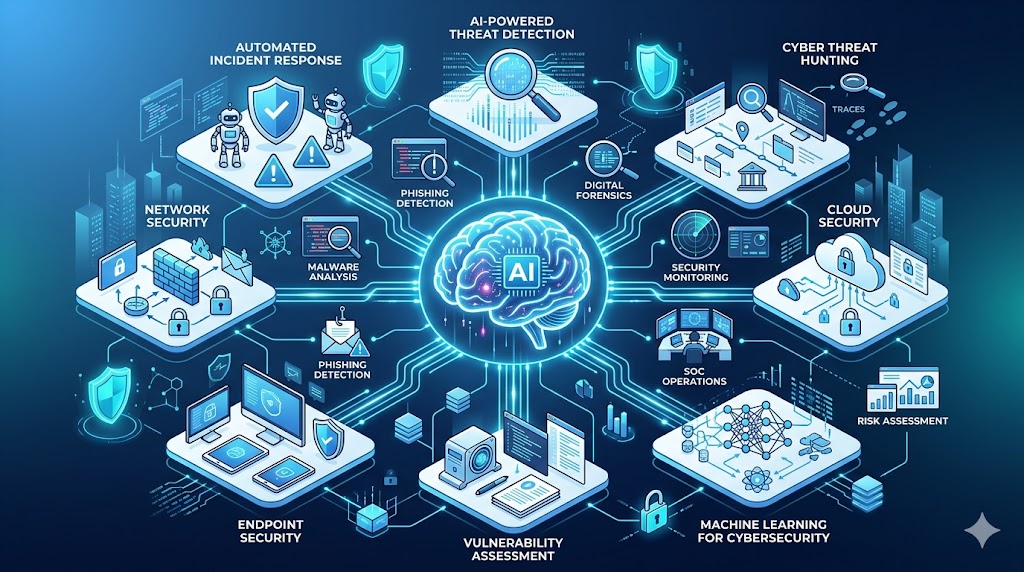
A Cyber Security with AI course combines traditional cybersecurity concepts with artificial intelligence technologies to improve threat detection, incident response, and security automation.
AI-powered cybersecurity helps organizations detect threats faster, automate security operations, and defend against sophisticated cyberattacks.
Students, IT professionals, cybersecurity enthusiasts, network engineers, ethical hackers, and career switchers can enroll.
Basic programming knowledge is helpful but not mandatory for beginner-level courses.
You can work as a Cyber Security Analyst, SOC Analyst, Ethical Hacker, Penetration Tester, Threat Intelligence Analyst, or AI Security Specialist.
AI-powered cybersecurity uses artificial intelligence and machine learning algorithms to identify, prevent, and respond to cyber threats.
AI analyzes large datasets in real time, identifies suspicious activities, and triggers immediate responses to potential threats.
Automated incident response uses AI-driven workflows to detect, contain, and remediate security incidents without manual intervention.
Threat intelligence involves collecting and analyzing information about cyber threats to proactively defend systems and networks.
Malware analysis is the process of studying malicious software to understand its behavior, impact, and methods of infection.
AI analyzes email patterns, sender behavior, and content to identify phishing attacks before they reach users.
Ethical hacking with AI involves using AI tools to discover vulnerabilities and simulate cyberattacks for security testing.
Penetration testing is a controlled cybersecurity assessment that identifies security weaknesses by simulating real-world attacks.
Vulnerability assessment helps organizations identify and prioritize security weaknesses before attackers exploit them.
A SOC is a centralized team responsible for monitoring, detecting, and responding to cybersecurity incidents.
Students learn security monitoring, incident response, threat hunting, log analysis, and security analytics.
Cyber threat hunting is a proactive process of searching for hidden threats that may bypass traditional security controls.
Attack pattern analysis examines attacker behavior and tactics to predict and prevent future cyberattacks.
Network security protects communication systems, devices, and data from unauthorized access and cyber threats.
Endpoint security protects devices such as laptops, desktops, servers, and mobile devices from cyberattacks.
Cloud security protects cloud-based applications, infrastructure, and data from breaches and unauthorized access.
IoT security focuses on protecting connected devices and networks from cyber threats and vulnerabilities.
Cyber forensics involves collecting and analyzing digital evidence after a cybersecurity incident.
Digital forensics investigates cybercrimes by examining digital devices, networks, and stored data.
Information security management ensures that security policies, procedures, and controls protect organizational assets.
Risk assessment identifies potential threats, while mitigation strategies reduce their impact on business operations.
Security analytics uses data analysis techniques to identify, investigate, and respond to cybersecurity threats.
Security automation uses software and AI tools to automate repetitive security tasks and improve efficiency.
Adversarial AI security focuses on protecting AI systems from manipulation, data poisoning, and machine learning attacks.
Machine learning enables cybersecurity systems to detect anomalies, predict threats, and improve defense mechanisms continuously.
Also read: Best data science with Ai course in Delhi








Your information will never be shared with any third party